
'Rolling Stone,' an object you might come across in Helmond but might not be able to place just like that. Not a bicycle, not a cart, but a large, angular art object made of wood and steel. 140 pounds heavy and anything but inconspicuous.
Falling Stones is the original name of the work, from exhibition to rover
Falling Stones. From the hands and brain of artist Art van Triest, and created for the exhibition Being on the Grid, in which Art explores how our need for order clashes with reality. The object resembles a tightly constructed element that has just become unbalanced: a form that tilts, chafes and doesn't fit neatly into the grid from which it seems to come. That is also what makes it such an idiosyncratic work. A sculpture that shows that systems can falter.
But after the exhibition in the Cacaofabriek it no longer had a permanent place. Too big to just put anywhere, too special to disappear. Dismantling even threatened. That's where Helmond artist Maurice van Venrooij latched onto it. "I just think it's a really cool object," Maurice said. Art marveled that Maurice always knows how to find new places. Instead of an end point, it became a new beginning. Maurice adopted the work and came up with Rolling Stone: a project in which the artwork does not stand still, but continues to roam through Helmond. From place to place, again and again in a different context. And that wandering does not happen silently.
Art that happens to you
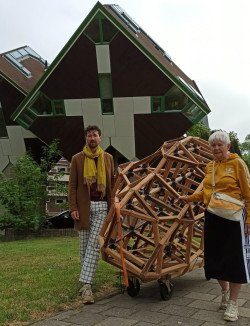
Who encounters the object sees not only the work, but also its movement. Moving itself is part of the project. Literally by hand, through the city, along streets and squares where you wouldn't normally expect art to go. And that's where something happens.
"When you go to a museum you're set up for an art experience. Not now," Maurice says. "A visit to the supermarket is suddenly colored with something unexpected." Along the way, there is a lot of attention. Children come to take a look. Sometimes people stop on the street to take a video or ask what you're doing. City employees even asked if Maurice wanted to roll the Rolling Stone through the House for the City, and in one office people interrupted a meeting to watch and wave. "They look up for a moment from their daily routine. That's already very nice. Sometimes people also pretend it's not there, and that's fine too. Art doesn't have to touch everyone."
Art: "You see it happening here on campus, too. People walking by and turning around to take another look. What is this, what is it doing here? Just different thoughts than you have every day. The work happens to you for a moment." That's exactly where Rolling Stone makes a difference. Not everyone steps into a museum, but art you encounter along the way asks nothing of you except a glance. Maybe wonder, maybe confusion, maybe nothing at all. And that, too, is good.
Grip
Underneath that apparent simplicity is a layered idea. It is no coincidence, then, that these two artists are carrying this project together. Their work shares a similar tension.
Maurice makes paintings and murals. "From a tight self-imposed system, I build my paintings layer by layer, but it is the human hand that executes it. With all the inevitable deviations as a result. For me, these imperfections are not a fault but a condition to counterbalance the doctrine of too rigid a system."
Art thinks and philosophizes with its hands. "As an artist, I want to stretch the 'normal'. To show that we don't always need conclusions." The way we try to order the world plays a big role in his work. "We create systems, structures and frameworks to get a grip on what cannot actually be fully captured. Falling Stones chafes at exactly that point." Between control and letting go of it. Between tight and unruly.
That's what Rolling Stone is about. Because the work keeps moving, that tension remains visible. It wants not just to be looked at, but experienced.
Art on our campus
The arrival of Falling Stones to the Brainport Human Campus felt logical. A place where people think about the relationship between people and work on a daily basis, and where the human dimension is central. Not the system as a starting point, but the human himself.
The relationship between art and the workplace has also been thought through here. Art creates an inspiring environment. It encourages seeing in new ways and can help find innovative solutions. It challenges different conversations, new connections and can even contribute to stress reduction.
Maurice here hopes especially for a brief moment: a smile, a thought, a joke about a spaceship or boulder. "People are completely free to think, feel or think something about it. But I hope I surprise them. I often say about my own work that I did half the work. I thought it up and made it. The other person, the viewer, gets to do the other half.
I especially want to introduce people to art at an unexpected moment. Or actually not even necessarily with art, but to create an unplanned moment. If, after seeing the work, they move on with a smile, the project is successful."
This way, the artwork on campus almost takes on an extra layer: it invites people to look differently, without having to understand anything.
Never finished and always on the move
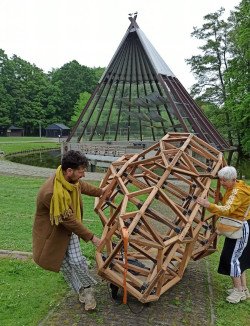
For residents, visitors and everyone who walks around here, it is above all an unexpected guest. One who stays for a while, releases something and then moves on. Maurice: "My goal was to keep the object 'alive' as long as possible. It would be nice if it were allowed to stay in Helmond for a while longer and perhaps receive a special status. Nothing official, but becoming a small part of the Helmond identity."
So in August, the Rolling Stone will go to Carolus Borromeus College. Students will then pick it up again at the Brainport Human Campus. And that's what it's all about. Work is never finished, never at home in one place. It lives precisely by moving, by new contexts and new encounters. And somewhere in Helmond, in the next place, that story just starts all over again.